Why Taking Your Idea Apart Comes First
Most ideas arrive as one whole thing. You picture the finished product, the moment it solves a problem, the person using it and feeling relieved. That mental picture is valuable, but it is not something anyone can build, evaluate, or protect.
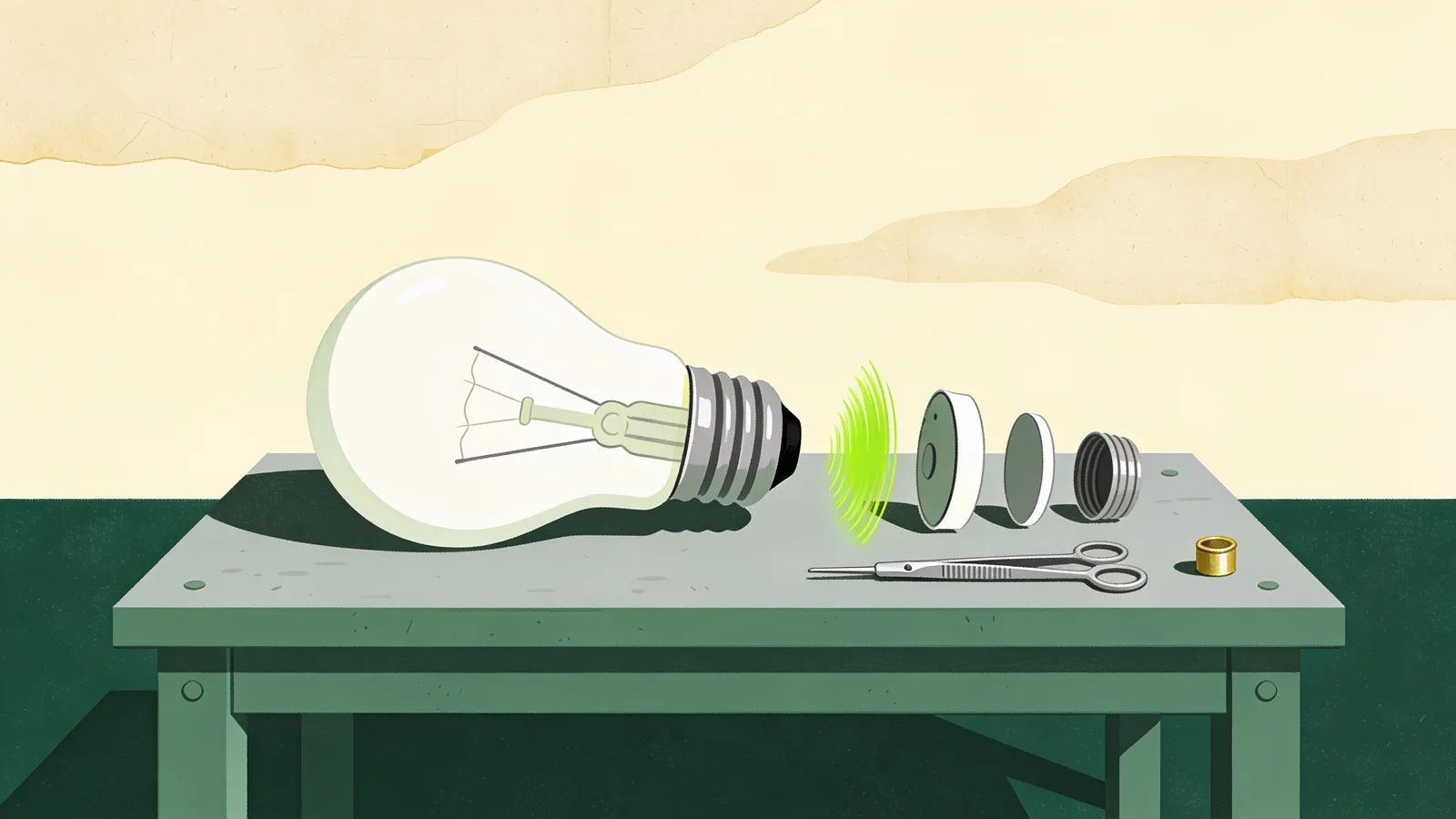
Before you talk to a manufacturer, a designer, or a patent attorney, you need to break the idea into its parts. This is the work that comes before the professionals get involved, and it is work you can do yourself with a notebook and some patience.
Component breakdown is not a bureaucratic step. It is how you find out whether your idea is one invention or three. It is how you spot the part that is actually new versus the parts that already exist and are simply being combined in a new way. That distinction matters more than most people realize.
Start With Function, Not Form
A common mistake is describing an invention by what it looks like. A better starting point is describing what each part does.
Take any object you already own and try this: instead of saying "it has a curved handle," say "it has a piece that lets the hand grip it at an angle that reduces wrist strain." The second version tells you the function. The function is what you are actually protecting or improving. The shape is just one way to deliver that function.
Go through your idea and list every function it needs to perform. Not features, functions. A feature is a decision you made. A function is a problem the feature solves.
The Component Breakdown Method
Once you have your list of functions, assign each one a physical or digital component. Here is a simple structure to follow.
1. List every function
Write down every job your invention needs to do. Hold something, sense something, connect to something, block something, release something. Be exhaustive here, even if some items seem obvious.
2. Assign a component to each function
For every function, name the part responsible for it. Sometimes one component handles several functions. Sometimes one function needs several components working together. Both are fine. What matters is that nothing is left unassigned.
3. Identify the material or method for each component
For physical inventions, ask what each part is made of and why. Plastic, metal, fabric, a specific alloy, a coating. For software or process-based ideas, ask what method or logic each component uses. A sorting algorithm, a sensor threshold, a sequence of steps.
This step often reveals gaps. You might realize you have a clear idea of what a component does but no idea what it should be made of, or that the material you assumed would not actually hold up to the function you need.
4. Note the connections between components
Inventions fail on paper and in prototypes at the connection points, not the parts themselves. How does component A attach to component B. Does it need to move, seal, conduct, insulate, flex. Write this down even when it feels obvious. It rarely stays obvious once you try to build it.
Why This Matters for Prior Art
Prior art is the term for everything that already exists in public: patents, products, articles, videos, anything that shows an idea similar to yours was already known. Checking for prior art is one of the first things a patent attorney will help you think through, and it is also something you can start exploring yourself.
Here is the part people miss: prior art searches are far more useful when you search by component, not by your invention as a whole. Searching for "a device that helps people carry groceries more comfortably" will bring you a flood of unrelated results. Searching for "handle grip material that reduces wrist strain during load bearing" gets you much closer to what actually matters.
When you break your invention into components, you create a set of precise search terms instead of one vague concept. This is often the difference between a search that feels random and one that gives you a real sense of the landscape.
Separating What Is New From What Is Borrowed
Most inventions are not entirely new from top to bottom. They combine existing components in a new arrangement, or they take a known component and apply it to a new problem. This is completely normal and describes a large share of everyday inventions.
Once you have your component list, go through it and mark each one honestly:
- Already exists and is being used in a standard way
- Already exists but is being used in an unusual context
- Appears to be new, as far as you can tell
This is not a legal determination. Whether something may qualify for patent protection is the kind of question a patent attorney would ask after reviewing a real search and your specific claims. But doing this sorting exercise yourself tells you where to focus. If nine of your ten components are standard parts and one is a genuinely new combination or material, that one component is where your real value and your real questions live.
Materials Deserve Their Own Pass
Components describe what a part does. Materials describe what it is made of, and this deserves a separate round of thinking because material choice often is the invention.
Ask these questions for each physical component:
- What material was I assuming, and why
- What would happen if this were made of something cheaper
- What would happen if this were made of something more durable
- Does the material affect weight, cost, safety, or how it can be manufactured at scale
A lot of strong inventions are not new shapes. They are known shapes made from a material nobody had applied there before. Breaking your invention apart by material, not just by part, often surfaces this.
Turning the Breakdown Into Something Useful
Once you have functions, components, materials, and connections mapped out, you have something far more useful than a description. You have a working document that a manufacturer can quote against, a designer can sketch from, and a patent attorney can review with actual specifics instead of a general concept.
This is also the point where you start to see the shape of the real invention. Sometimes it turns out to be the whole assembly. Sometimes it turns out to be one component or one material application, with the rest being standard parts arranged to support it. Either way, you now know, instead of guessing.
A Simple Way to Start Today
Take a blank page and draw a box for your invention in the middle. Draw lines out from it for every function you can think of. For each function, write the component responsible. For each component, write the material or method. Then look at the connections between them.
You do not need special software or training to do this. You need honesty about what you actually know and what you are still assuming. That clarity is worth more at this stage than any amount of enthusiasm about the finished idea, and it puts you in a far stronger position for the strategy session that comes next, whenever you are ready for it.