The Direct Answer
A startup idea pressure test tool works by arguing against your idea, not for it. The best ones use what we call adversarial thinking and hard reasoning: a method where an AI advisor is built to find the weak points in your idea, check them against real-world evidence like prior art (existing products, patents, and public disclosures that came before you), and hand you a verdict you can actually act on. If a tool only compliments your idea, it is not pressure testing anything.
That is the whole concept in two sentences. The rest of this guide explains why most "critique my business idea" tools fail at this, what adversarial thinking actually looks like in practice, and how to run a real pressure test on your own idea this week.
Why Most Idea Feedback Is Useless
Ask a general AI chatbot to critique your business idea and watch what happens. It tells you the idea is interesting. It lists three strengths. It offers a gentle suggestion or two, usually about "knowing your audience" or "testing with users." Then it wishes you luck.
That is not feedback. That is politeness dressed up as analysis.
The problem is structural, not a matter of asking better questions. General-purpose AI tools are trained to be agreeable. They are optimized to keep you talking, not to tell you something you do not want to hear. If you want a tool that critiques your business idea honestly, you need one built with a different goal: finding out where the idea breaks, not making you feel good about it.
This is where the idea of an adversarial thinking and hard reasoning AI advisor matters. It is not a chatbot with a stern tone. It is a system designed around a specific job: take the position against your idea and see if it survives.
What "Adversarial Thinking and Hard Reasoning" Actually Means
Break the phrase into its two parts.
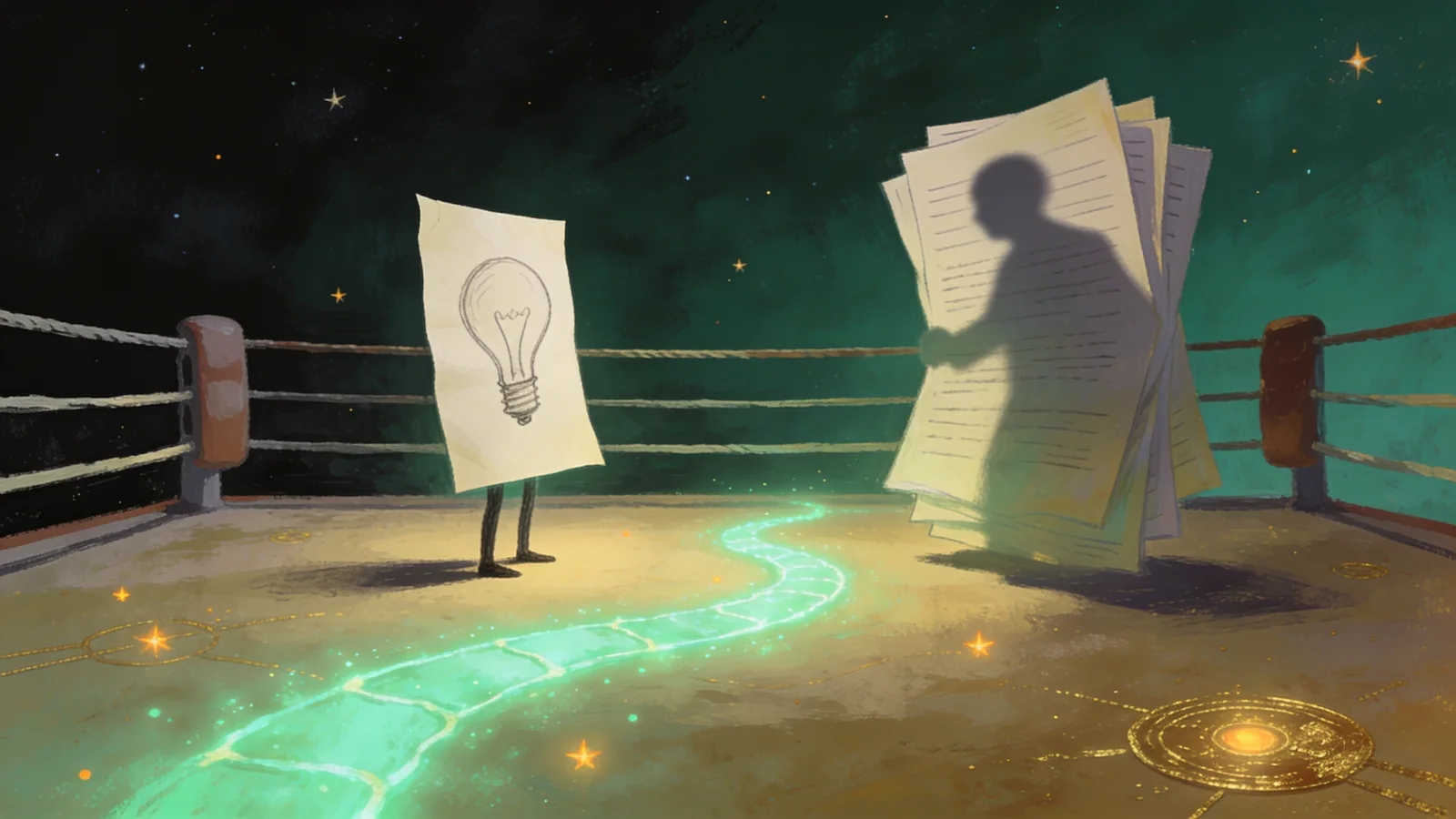
Adversarial thinking means the advisor's job is to argue the other side. Instead of asking "what do you like about this idea," it asks "why would this fail," "who else has tried this," and "what happens if a competitor with more money copies this next month." A good adversarial process treats your idea the way a skeptical investor, a patent examiner, or a blunt cofounder would: with polite disbelief until proven otherwise.
Hard reasoning means the critique is backed by evidence and logic, not vibes. It is the difference between "this feels crowded" and "here are eleven existing products and filings that overlap with your core mechanism, and here is why that matters for how you'd position and protect this." Hard reasoning shows its work. It cites what it found instead of asserting a conclusion.
Put together, an adversarial thinking and hard reasoning AI advisor is a tool built to stress-test an idea the way a rigorous, honest advisor would, using real search and real logic instead of encouragement. It is the organizing idea behind a genuine startup idea pressure test tool, and it is different from a generic "AI business idea generator" or feedback bot in one crucial way: it is trying to break your idea before the market does.
What a Real Pressure Test Actually Checks
A proper pressure test does not stop at "is this a good idea." That question is too vague to answer honestly. Instead, it breaks the idea into parts that can each be checked.
1. Does something like this already exist?
This is the prior art question. Prior art means anything publicly disclosed before your idea, whether that is a granted patent, a pending patent application, a product on a shelf, a forum post, or a crowdfunding page from five years ago. A pressure test should search broadly for this, because "nobody's doing this" is one of the most common and most wrong things founders believe about their own idea. Knowing what already exists does not kill your idea. It tells you what you're actually up against, and it shapes how you build the thing so it stands apart. This is one factor that tends to matter when a patent attorney later looks at whether an idea may qualify for protection, so getting an honest early read matters more than most people assume.
2. Does the mechanism actually work, or does it just sound good?
A lot of ideas sound clever in a sentence and fall apart in an hour of scrutiny. A hard reasoning process pokes at the core mechanism: what has to be true for this to work, and what evidence supports that assumption right now.
3. Who would actually pay, and why would they switch?
An idea can be original and mechanically sound and still fail commercially because nobody has enough pain to change their habits. Adversarial thinking pushes on this directly instead of assuming a market exists because the idea is exciting to you.
4. What would a smart competitor do to beat you?
This question rarely occurs to a solo founder in the excitement phase. A pressure test tool worth using will simulate that competitor and tell you where they would attack.
If you want a deeper walkthrough of assigning specific roles to this kind of scrutiny, including the parts a real advisory board would normally play, an AI advisory board for solo inventors explains how to structure the process from multiple angles instead of one flat critique.
Why This Belongs Before You Talk to an Attorney
A patent attorney is expensive, and rightly so. Their time is best spent on strategy and filing decisions, not on the first round of "does this seem to already exist" digging. A pressure test tool that does prior art searching and honest critique up front means that by the time you do talk to an attorney, you are bringing a sharpened idea and a clear picture of the landscape, not a raw guess.
This is the gap EntreDash was built to fill: the work that happens before the attorney, made for an ordinary person with an idea rather than a law firm. You do not need credentials to be an inventor. You need a way to find out, honestly and early, whether your idea holds up.
How to Pressure Test Your Own Idea This Week
You do not need to wait for a perfect tool to start being adversarial with yourself. Here is a version you can run manually, even before using any software.
Write the idea in one sentence. If you cannot state it plainly, you cannot pressure test it. Vague ideas dodge scrutiny by accident.
List the three most obvious existing alternatives. Not competitors exactly, whatever a person currently does instead of your idea. If you cannot name three, look harder before assuming there are none.
Search for prior art yourself, at least loosely. A basic search across patent databases and general product searches will surface a surprising amount. This is not a substitute for a thorough professional search, but it is a fast gut check.
Ask what happens if you're right and boring. Sometimes an idea's biggest risk is not that it's impossible, but that it's mildly useful and easily copied. That is a commercial risk, not a legal one, and it deserves its own honest look.
Write down the single strongest argument against your idea. Not a soft one. The one that would actually worry a smart, skeptical friend. If you cannot generate that argument yourself, that is a sign you need an outside adversarial process, because you're too close to see it.
If you want a more structured version of this same exercise, with prior art search and a clear verdict instead of a DIY checklist, EntreDash's free idea assessment runs this pressure test directly on your idea and shows you what it finds, and the methodology page explains exactly which databases get searched and how findings get cited, so you know what you're looking at.
If You Don't Have an Idea Yet
Not everyone starts with a fully formed idea to test. If what you have is a frustration or an everyday annoyance rather than a concept, that is a legitimate starting point too. Spark is built for that stage: it takes an everyday frustration and turns it into concrete business directions worth pressure testing in the first place.
A Pressure Test Is Not a Rejection
It is worth saying plainly: a hard critique of your idea is not the same as being told it is a bad idea. An adversarial process is designed to strengthen a good idea by finding its weak points early, while there is still time to fix them cheaply. The founders who skip this step are not braver, they are just gambling with more of their own time and money later.
A good pressure test does not hand you a simple yes or no. It hands you a clear picture: what exists already, where your idea genuinely differs, what would need to be true for it to work, and what a sharp competitor or a skeptical reader would attack first. From there, the decision about what to build, and when it might be worth a conversation with a patent attorney, is yours to make with real information instead of hope.
If you want to see how this fits into the bigger picture of moving from a raw idea to something buildable, how EntreDash works walks through the full process end to end, from that first pressure test through to the steps that come after it.