Why Prior Art Search Comes Before Anything Else
If you build things for a living, you already know the instinct to check what exists before you build more of it. You read the docs. You check the changelog. You look at how someone else solved the problem before you write your own version.
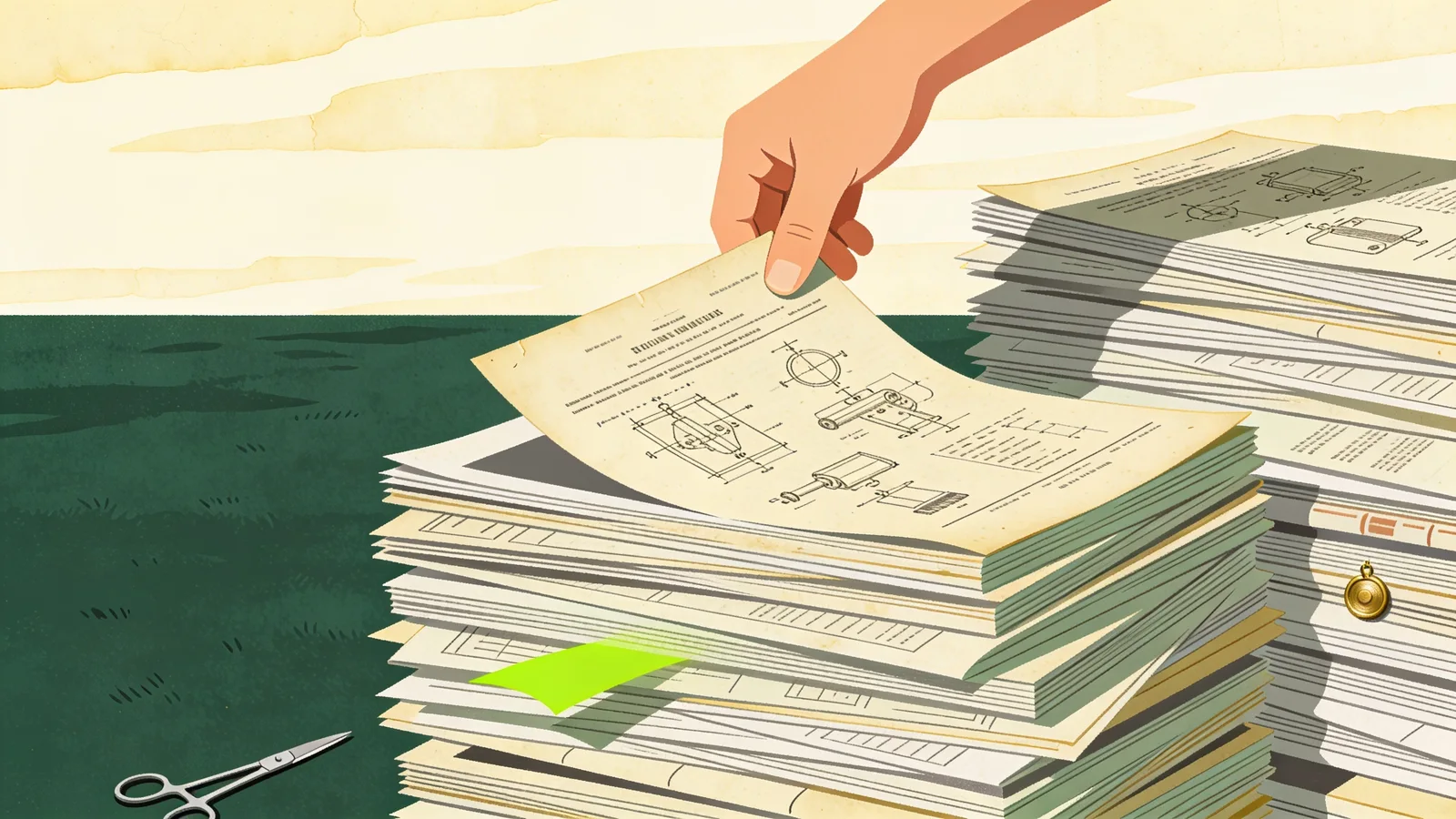
Patents work the same way, except the "docs" are called prior art. Prior art is any evidence that your idea, or something close to it, already exists in public. It can be a patent filed in 1998, a product manual, a forum post, a YouTube demo, or a paper from a conference nobody remembers. If it was made public before you filed, it counts.
A prior art search is the process of finding that evidence yourself, before a patent examiner does it for you. Skipping this step does not make your idea more original. It just means you find out later, after you have spent money on drafting and filing, instead of earlier, when it is cheap to find out.
What a Prior Art Search Actually Tells You
A good search will not tell you whether your idea is patentable. Nobody can promise that, and anyone who does is skipping a step. What it does tell you:
- What already exists that resembles your idea
- Which parts of your idea are common and which parts might be distinctive
- The language and structure the field already uses to describe this kind of thing
- Whether your idea is a variation on something well-trodden, or sits in a quieter corner
That distinction, common versus distinctive, is one factor that tends to matter a lot when a patent attorney evaluates whether something may qualify for protection. Your search is the raw material for that conversation. It is not a substitute for it.
Start With the Idea, Not the Keyword
The most common mistake technical people make is searching for their own terminology. If you call your invention a "dynamic load-balancing widget," you will search for that phrase and find almost nothing. Prior art rarely uses your words. It uses whatever the inventor called it at the time, in whatever field they came from.
Before you type anything into a search bar, break your idea into its actual function. Ask:
- What problem does this solve?
- What is the mechanism, the actual thing doing the work?
- What would this be called in an unrelated industry that solves a similar problem?
A sensor that adjusts based on temperature might show up in HVAC patents, automotive patents, or agricultural equipment patents, using none of your product's language. Search the function, not the branding.
Where to Actually Look
Patent databases
Start with free, public patent databases: Google Patents, the USPTO's full-text search, and Espacenet for international filings. These let you search by keyword, classification code, inventor, and date. Patent classification codes (CPC codes) are worth learning even a little, because they group patents by function rather than by wording, which solves the keyword problem above.
Non-patent literature
A huge amount of prior art lives outside the patent system. Academic papers, product datasheets, Kickstarter pages, GitHub repositories, conference talks, and even old forum threads can all count as prior art if they were public before your filing date. If you work in a technical field, you likely already know where the relevant literature lives. Search it the same way you would search for a patent.
Products already on the market
Sometimes the clearest prior art is a product you can buy right now. Check retail listings, industry catalogs, and trade show archives. A product that has been selling for five years is stronger evidence than an obscure patent application nobody built.
A Simple Search Process to Follow
- Write a one-paragraph description of your idea in plain language. No jargon, no branding. Just what it does and how.
- Pull out three to five core concepts from that paragraph. These become your search terms.
- Search each concept independently across patent databases and general search engines. Do not just search the combination.
- Follow the citations. When you find a relevant patent, look at what it cites and what cites it. Prior art tends to cluster.
- Note what's missing, not just what's present. If ten similar patents exist and none of them do the one thing your idea does differently, write that down. That gap is often the most useful thing you will find.
- Keep a record. Save links, dates, and screenshots. This becomes useful later, both for your own thinking and for a conversation with an attorney.
What to Do With What You Find
Finding close prior art is not a failure. It is information. Most inventions are improvements on something that already exists, not inventions from nothing. The question worth asking is narrower: does your version do something the earlier ones don't, in a way that is not obvious to someone else working in the field?
That question, obviousness, is genuinely one of the harder ones in patent law, and it is exactly the kind of question a patent attorney is trained to weigh. Your job at this stage is not to answer it. Your job is to arrive at that conversation with a clear map of what already exists, so the attorney is not spending billable hours doing the search you could have done yourself.
Common Mistakes Technical People Make
Searching only in your own industry. The most damaging prior art often comes from an adjacent field that solved the same underlying problem for a different reason.
Stopping after the first few results. A shallow search feels thorough because the first page looks empty. Patent databases bury relevant results under classification quirks and inconsistent language. Depth matters more than breadth here.
Treating a clean search as a green light. Not finding prior art does not mean none exists. It might mean you searched the wrong terms, the wrong databases, or the wrong language. A thin search result is not the same as a strong one.
Confusing "nobody sells this" with "nobody described this." A patent application from a company that never built or shipped the product can still count as prior art. Absence from the market is not absence from the record.
Why This Matters Before You File, Not After
Once you file, your description of the invention is locked in. If prior art surfaces later, during examination or after a competitor challenges your patent, you cannot go back and reshape your claims around it as easily. Doing the search early means you can adjust your thinking, narrow your focus onto what's actually distinctive, or decide the idea needs more development before it's worth the cost of filing.
This is the quiet, unglamorous work that happens before anyone talks to an attorney. It does not require legal training. It requires patience, a willingness to read dry documents, and the same instinct that makes a good engineer check the existing codebase before writing new code: look first, build second.
The Honest Takeaway
A prior art search will not tell you whether you have a patentable invention. It will tell you what you are standing on, and whether there's room to stand on it in a new way. That is a smaller promise than most guides make, but it is the one that actually holds up. Everything after that, the claims, the strategy, the filing decision, works better when it starts from a search you actually did, not one you assumed away.