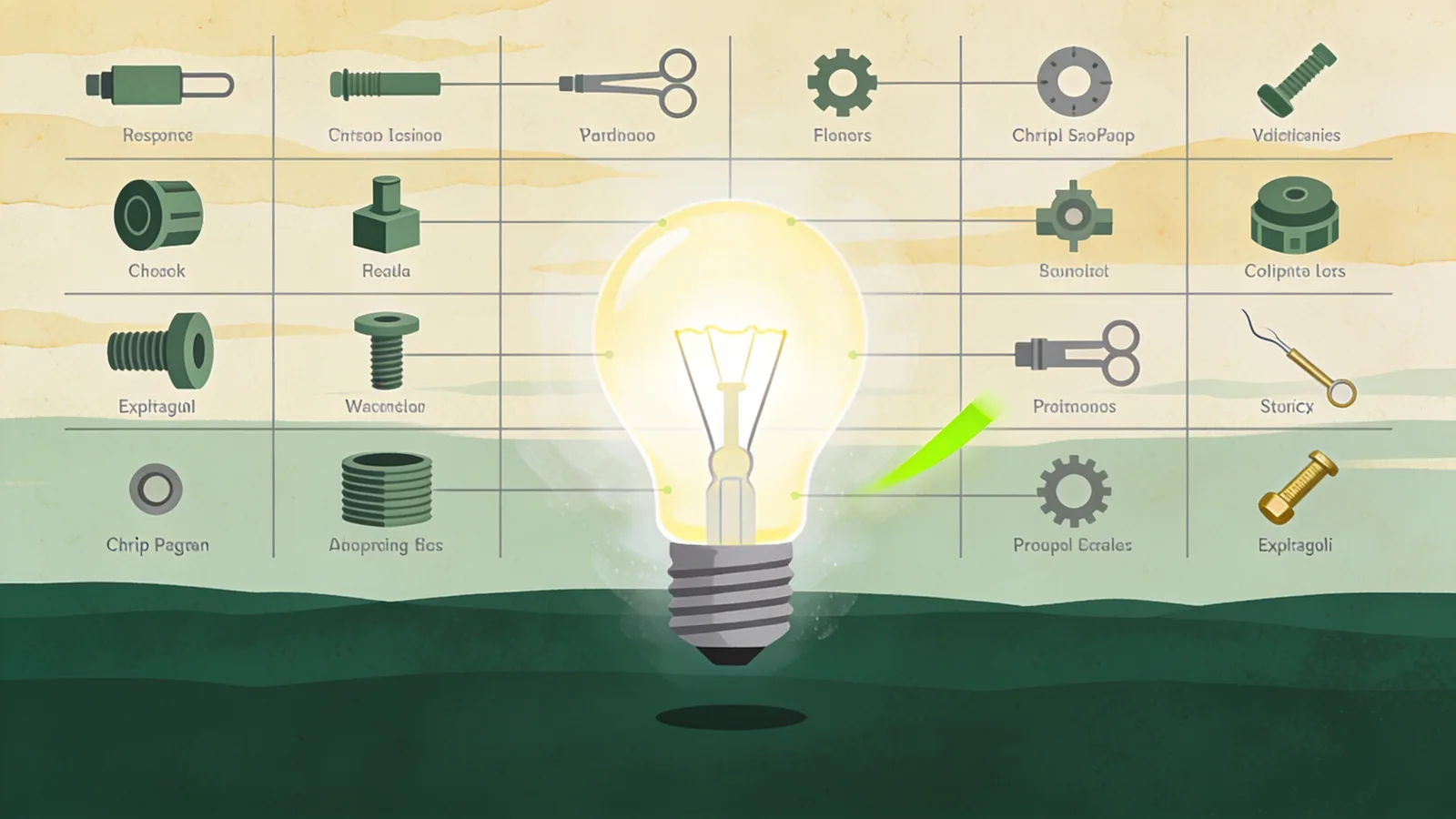
The Gap Between an Idea and a Thing
Most ideas die in a strange spot. Not because they are bad, but because nobody turns them into a list of parts.
You can describe your idea in one sentence. You might even sketch it on a napkin. But if someone asked you right now, "what does this actually need to exist," could you answer? Not the concept. The materials. The components. The things you would order, cut, mold, or wire together.
That gap, between concept and parts list, is where most ideas quietly stall. This article walks through how to close it.
Why a Parts List Matters More Than a Pitch
A pitch convinces people your idea is worth attention. A parts list proves it can exist. These are different jobs, and working professionals often do the first one well and skip the second entirely.
A real parts list, sometimes called a bill of materials, does three things:
- It forces you to stop describing your idea and start defining it.
- It gives you a document you can hand to a manufacturer, a machinist, or a prototyping shop.
- It becomes the backbone of almost everything that comes after: cost estimates, prototypes, and eventually, if you go that route, a conversation with a patent attorney about what is actually novel.
You cannot source "a smart water bottle that reminds you to drink." You can source a housing, a sensor, a battery, a microcontroller, an LED ring, and a charging port. One of those is a daydream. The other is a project.
Step One: Separate the Function From the Form
Before you list parts, separate what your idea does from what it looks like. This sounds basic, but it is the step most people skip.
Write down every function your idea performs. Not features, functions. A feature is "tracks your water intake." A function is "detects when liquid passes through a channel and counts the volume."
Functions point you toward mechanisms. Mechanisms point you toward parts. Features just point you toward marketing copy.
Try this exercise: take your idea and describe it using only verbs. What does it sense, hold, release, rotate, heat, cool, connect, or block? Each verb usually maps to a category of component.
Step Two: Break the Idea Into Subsystems
Most ideas, even simple ones, are made of smaller systems working together. A tote bag with a built-in phone charger has a structural subsystem (the bag itself), a power subsystem (battery, wiring, port), and sometimes a data subsystem (if it tracks charge levels).
Breaking your idea into subsystems does two useful things. It makes an overwhelming idea feel manageable, and it reveals which parts of your idea are genuinely new versus which parts are standard, off-the-shelf components doing an ordinary job.
That distinction matters later. Prior art, meaning existing patents, products, and public information that show what already exists in your space, almost always covers the standard components. The question worth sitting with is usually about how the subsystems connect or interact, not about any single part in isolation.
A Simple Framework
For most physical products, subsystems fall into a few buckets:
- Structure: what holds everything together (housing, frame, fabric, casing)
- Power: batteries, cables, charging components, or none at all if it is fully mechanical
- Mechanism: moving parts, latches, hinges, gears, springs
- Electronics: sensors, chips, boards, connectors
- Interface: buttons, screens, dials, anything a person touches or reads
Not every idea needs all five. A better can opener might only need structure and mechanism. A wearable might need all five plus software. List which buckets apply to your idea before you list a single part.
Step Three: Name the Actual Parts
Once you know your subsystems, name real, sourceable components inside each one. This is where vague language has to go away.
Instead of "a sensor," write "a capacitive touch sensor" or "an infrared proximity sensor," depending on what the function actually requires. Instead of "a battery," write "a rechargeable lithium polymer cell, roughly 500mAh."
You do not need to be an engineer to do this. You need to search. Look at how similar products describe their internals. Read product teardowns. Browse component marketplaces like Digi-Key, McMaster-Carr, or Alibaba, not to buy yet, but to see what real categories and specifications look like. This step alone often clarifies an idea faster than weeks of just thinking about it.
Write each part down with:
- What it does in plain language
- A general category (so you can search for alternatives later)
- A rough size or spec, even if it is a guess
- Whether it is standard (easy to buy) or custom (needs to be made)
That last column matters. It quietly tells you where your idea's cost, difficulty, and possibly its distinctiveness actually live.
Step Four: Separate Standard Parts From Custom Parts
Most ideas are a mix of parts anyone can buy and parts nobody makes yet. Sorting your list this way changes how you think about the whole project.
Standard parts are good news. They mean lower cost, faster sourcing, and less risk. A hinge, a zipper, a common battery, a generic bracket, these exist because thousands of products already need them.
Custom parts are where the real work lives. If your idea needs a bracket shaped a specific way, or a housing with an unusual cavity, or a mechanism that does not exist off the shelf, that is often the part of your idea that is doing something different. It is also usually the part worth discussing with a patent attorney down the road, since novelty in an invention often lives in how custom elements interact with standard ones, not in the standard parts themselves.
This is not a legal claim, just a pattern worth noticing early. Nobody can tell you whether something is patentable from a blog post, and anyone who says otherwise is skipping a step. But knowing which parts of your idea are ordinary and which are unusual gives you a clearer picture before that conversation ever happens.
Step Five: Build a Simple Table
You do not need software for this. A spreadsheet with five columns works fine:
- Subsystem
- Part name
- Function (what it does)
- Standard or custom
- Where you might source it or who might make it
Filling this out for even a rough idea takes an afternoon, not months. And once it exists, everything gets easier. You can send it to a fabrication shop for a quote. You can estimate a prototype budget. You can talk to a manufacturer without sounding vague. You can even hand it to a patent attorney later as a starting document instead of trying to explain your idea from scratch in a strategy session.
Why This Step Comes Before Everything Else
People often want to skip straight to "is this patentable" or "how do I get this made." Both are fair questions, but both depend on this earlier step. A patent attorney cannot evaluate an idea that has no defined parts. A manufacturer cannot quote a product that has no bill of materials. Even a rough prototype needs a shopping list before it needs a soldering iron.
The parts list is not glamorous. It will not feel like the moment your idea became real, the way a working prototype does. But it is the quiet document that makes everything after it possible.
Where to Go From Here
Once your parts list exists, the next useful moves are usually:
- Rough cost estimates for standard parts
- A search for how similar products handle the custom parts (a light form of your own prior art research)
- A basic sketch or CAD file showing how the parts fit together
None of these require an attorney, a lab, or a manufacturing background. They require the willingness to treat your idea like a system instead of a slogan.
An idea that started as a thought in the shower does not become a product through more thinking. It becomes one through a list, a real, specific, sourceable list of what it is actually made of.