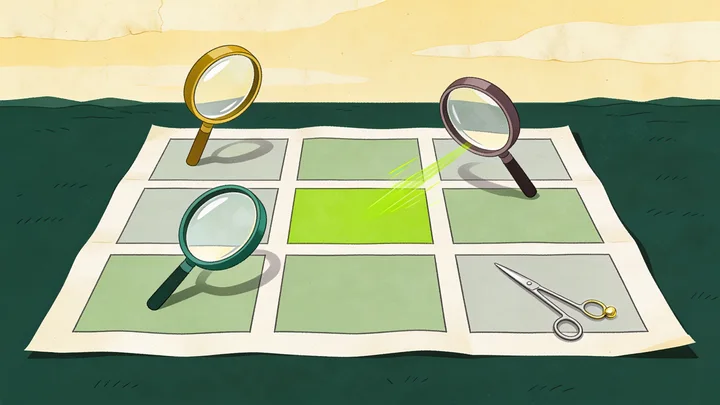
Can an AI advisor actually stress test a SaaS business model canvas?
Yes, in a specific sense. A structured advisory process can take each block of a business model canvas, the value proposition, customer segments, revenue streams, cost structure, and pressure it with pointed questions the way a Product Strategist, an IP Consultant, and a Financial Analyst would in a real strategy session. It will not tell you your SaaS idea will succeed. It will tell you which assumptions are load-bearing and which ones you have not actually tested yet.
That distinction matters more than it sounds. Most canvases fail quietly. They look complete on a whiteboard because every box has words in it, not because every box has evidence behind it.
Why does a business model canvas look finished when it isn't?
The canvas format rewards completeness over rigor. Nine boxes, all filled in, feels like a finished map. But a box filled with a guess looks identical to a box filled with data.
Founders building SaaS products are especially exposed to this. The product itself is intangible, so it is easy to write a confident sentence in the "value proposition" box without ever describing the specific person who has the problem, how often they feel it, or what they currently do instead of your product. Stress testing means going back through each box and asking, out loud, "how do I know this is true" rather than "does this sound reasonable."
What does "stress testing" actually mean for a canvas?
Stress testing means deliberately trying to break each assumption before a customer, competitor, or investor does it for you. For a SaaS canvas, that usually means checking:
- Whether the customer segment is specific enough to actually find and talk to, not just a demographic label
- Whether the revenue model (subscription tiers, usage-based pricing, seat-based pricing) matches how the customer already buys similar tools
- Whether the cost structure accounts for the ongoing costs of a SaaS business specifically: hosting, support, churn-driven customer acquisition cost, not just build cost
- Whether the channels assumption is realistic for a solo or small team, versus something that assumes a sales team that does not exist yet
A structured advisory conversation walks through these one at a time instead of eyeballing the whole canvas at once, which is where a personal innovation workspace becomes useful: it keeps the canvas, the questioning, and the resulting notes in one connected place instead of scattered across sticky notes and slide decks.
What questions does a Product Strategist ask about a SaaS canvas?
A Product Strategist tends to push on the value proposition and customer segment boxes first, because those two boxes drive everything downstream. Typical questions look like:
- "Who exactly has this problem, and how are they solving it today without your product?"
- "What would make them switch, given that switching software has real friction?"
- "Is this a nice-to-have or does it sit close to something they already pay to fix?"
These are not trick questions. They are the same questions a skilled advisor or early customer conversation would surface, just asked systematically instead of hoping they come up eventually. If you're doing this alone without a cofounder or team to argue with, this kind of structured back-and-forth is close to what's described in how you use AI for customer discovery when building alone.
What does a Financial Analyst check on a SaaS canvas?
The Financial Analyst role focuses on whether the numbers in the revenue and cost boxes actually connect to each other. Common checks include:
- Does the pricing tier structure support the cost of serving each tier, including support and infrastructure
- Is the customer acquisition cost assumption realistic for the proposed channel, or borrowed from a much larger company's playbook
- What churn rate would break the model, and is that churn rate plausible for this category of SaaS product
- How many paying customers are actually needed to reach a sustainable monthly recurring revenue, stated plainly rather than left vague
This is where a lot of early SaaS ideas quietly fall apart. The product might be genuinely useful, but the unit economics assumed in the canvas don't hold up once you write the numbers down instead of gesturing at them.
Where does an IP Consultant fit into a SaaS canvas review?
It might seem odd to bring intellectual property into a business model conversation, but two boxes on a SaaS canvas usually have IP implications worth flagging early: the value proposition and the cost structure.
If part of your value proposition rests on a specific technical method, workflow, or algorithm, that may be worth examining for prior art, meaning existing publications, patents, or products that describe something similar. This is not a claim that anything is or isn't patentable; it's a factor that tends to matter when deciding how much of your differentiation is defensible versus easily copied. An IP Consultant flags this early so it doesn't become a surprise later, and a deeper look at how that kind of screening works is covered in how an advisory board helps with prior art and patentability research.
Brand and naming also fall under this lens. A distinctive product name or interface design pattern is the kind of thing worth checking before it's baked into marketing spend.
How is this different from just filling out the canvas yourself?
Solo, most founders fill in the canvas with the answer that feels right in the moment, then move on because the box is technically complete. A structured, three-advisor pass through the same canvas does something different: it asks a follow-up question after the first answer, the way a skeptical cofounder or an experienced mentor would.
That follow-up is where the actual stress testing happens. "Who is your customer" gets a confident answer. "How many of those customers have you actually spoken to, and what did they say when you described the price" gets a much shorter, more honest answer, and that gap is the useful part. This kind of layered questioning is explored in more depth in what happens when you walk an idea through an AI startup advisory board and in can an AI advisory board pressure test your business model canvas.
What comes out of a stress-tested canvas that a plain one doesn't have?
A canvas that has been through this kind of review usually ends up with three things a first draft doesn't:
- Flagged assumptions, meaning boxes explicitly marked as guesses rather than validated facts
- A short list of what to test next, such as a specific customer interview question or a pricing experiment
- An early read on defensibility, meaning a rough sense of what part of the idea is genuinely differentiated versus easily replicated
None of this replaces a real conversation with real customers, and it's not a substitute for sitting down with a patent attorney once the IP questions get specific. But it gives you a clearer, more honest starting point before you spend money building something.
Where can you actually try this with your own idea?
If you want to see how this plays out with a specific SaaS concept rather than in the abstract, the free advisory board on EntreDash walks an idea through the same three-lens review described above: product, IP, and financial. You can also see the full process, from ideation through financial projections, on the how it works page, and read more foundational context in the IP Education Center if the prior-art side of things is new territory.
Spark to business starts with an honest look at the canvas you already have, not a bigger one.