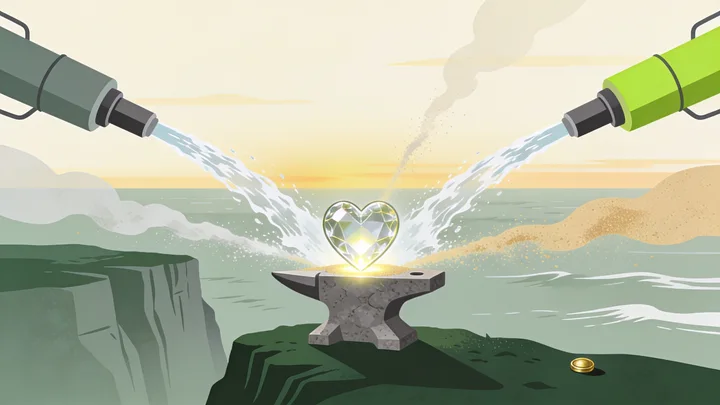
What does it mean to "red team" a business idea?
Red teaming a business idea means assigning someone (or something) the job of trying to break it, on purpose, before the market does it for you.
The term comes from military and cybersecurity exercises, where a "red team" attacks a plan to find its weak points while a "blue team" defends it. Applied to a startup idea, it means running your concept through deliberately skeptical questions: Does this solve a real problem? Has someone already patented this? Would anyone actually pay for it?
Most aspiring founders skip this step. They fall in love with an idea, build a prototype, and only then discover a competitor already owns the core mechanism, or that the target customer does not feel the pain as sharply as they assumed. Red teaming flips the order. You find the holes on a Tuesday afternoon instead of eighteen months and several thousand dollars later.
What is "medtech startup idea validation" and why does it need its own category?
Medtech startup idea validation is the practice of testing a medical or health-technology idea across three dimensions at once: whether people actually need it, whether it can be defended as intellectual property, and whether it can support a real business. It matters as its own category because medtech ideas carry risks that a generic "startup idea" checklist does not cover.
A wearable glucose sensor or a diagnostic app is not just competing on user experience. It is entering a space full of dense patent filings, FDA-adjacent regulatory questions, and reimbursement models that decide whether a hospital or insurer will ever pay for it. A general-purpose validation exercise built for a consumer app misses most of this. Medtech startup idea validation exists because the stakes and the evidence trail are different, and treating it as a distinct discipline is the only way to actually catch the problems that matter.
This is the organizing lens worth using even outside strict medtech: think in terms of need, defensibility, and financial grounding, evaluated together rather than one at a time.
How do you use AI market research for a startup idea?
AI market research works best as a first pass, not a final verdict. It can scan public data, industry reports, and search trends fast, surfacing patterns a person would take weeks to compile by hand.
A useful process looks like this:
- Describe the problem the idea solves, in plain language, before describing the solution.
- Ask for evidence that people search for, complain about, or pay for a fix to that problem today.
- Ask what adjacent products or workarounds already exist, and why they fall short.
- Ask what would have to be true about the market for this idea to reach a sustainable size.
The goal is not a green light. It is a sharper, more honest picture of the terrain. Tools built for product-market fit testing, like the ones discussed in this look at AI tools for product-market fit and needs discovery, can help structure that inquiry so it does not turn into a search for reassurance instead of truth.
What does AI startup idea validation actually check?
Good AI startup idea validation checks three separate things, and it should check them separately rather than blending them into one fuzzy score.
First, market validation: is there a real, underserved need, and is the target customer identifiable enough to reach? Second, prior art: has this idea, or something close to it, already been filed or built? Prior art is any public evidence, a patent, a product, a research paper, that shows an idea or a piece of it already exists; it is the term patent examiners and attorneys use when they compare a new idea against everything that came before it. Third, financial grounding: do the unit economics, even in rough form, suggest a viable business rather than an expensive hobby.
A single AI chat answer that says "looks promising" is not idea validation. Real validation produces a structured, evidence-based reading of all three dimensions, ideally reviewed the way a startup idea pressure test works for a medtech concept specifically: methodically, one weak point at a time.
Can AI actually tell you if an idea is patentable?
No tool, human or automated, can promise that an idea is or is not patentable. What a well-built prior art search can do is surface what already exists, which patents, products, and publications sit closest to your idea, so you can see the landscape clearly. Whether something ultimately qualifies for protection is the kind of question a patent attorney answers after reviewing the specific claims, and it depends on details a first-pass search is not positioned to resolve.
That distinction matters. A search that flags five or six adjacent patents is doing its job by giving you information, not by delivering a verdict. For a deeper look at how adversarial search techniques catch prior art that a simple keyword search misses, see this explanation of AI prior art search using adversarial logic.
How do you validate an AI-driven startup decision, not just the idea itself?
Validating the idea is the first layer. Validating the decision to actually build it, spend money on it, or quit a job for it, is a second, separate layer that many people skip.
A decision-level validation asks different questions:
- What is the smallest, cheapest version of this that could produce real evidence, before a full prototype?
- What would have to go wrong for this to fail, and how would you know early?
- Is the founder (that is you) the right person to build this, given the skills and time actually available?
- What does the cash runway look like for the first six to twelve months, honestly?
AI-assisted decision validation works best when it forces this kind of specificity rather than producing a vague confidence score. A model that just says "7 out of 10, good idea" gives you nothing to act on. One that says "your cost assumptions in year one look optimistic relative to comparable products" gives you a next step. For more on how much weight a single AI-generated score deserves, see this piece on whether an AI rating of your startup idea can be trusted.
What growth tactics actually work in the earliest stage of a startup?
Most early-stage growth advice is written for a company that has already found its first customers. The earlier problem, before growth even makes sense, is proving the idea deserves growth at all.
A few tactics hold up across most early ideas, medtech included:
- Talk to fifteen to twenty potential users before writing a line of code. Not a survey. A conversation, where you ask what they do today instead of your solution.
- Build the smallest artifact that can generate a real reaction: a one-page description, a clickable mockup, a paper prototype. Not a working product yet.
- Price it out loud early. Ask a real prospect what they would pay, before you have anything to sell. The number, or the silence, tells you something a market report cannot.
- Treat the first ten "yes" responses as data, not validation. Ten friendly people saying they would use it is weaker evidence than three strangers asking where to sign up.
Growth tactics that skip this sequence, paid ads, referral loops, content calendars, are built for a stage you have not reached yet. They work on a validated idea and waste money on an unvalidated one.
How does prior art screening fit into idea validation for a medtech concept?
Prior art screening is not a separate, later step reserved for a patent attorney. For a medtech idea, it belongs at the start, alongside market and financial checks, because so much of the medtech landscape is already patented, published, or in clinical trials somewhere.
A reasonable early screening pass looks for:
- Direct competitors with a similar mechanism or device design.
- Patents filed by larger medtech or pharma companies that cover a broader category your idea might fall inside.
- Academic or clinical publications describing the same approach, even informally.
None of this tells you whether your idea can be protected. It tells you whether the space is crowded, and where the open ground might be. For a full walkthrough of how this kind of check works for a life sciences concept, see how a proprietary AI workflow validates a life sciences startup idea. If you want to understand which sources a thorough search actually pulls from, the methodology behind prior art database searches lays that out.
How do the three checks, market, IP, and financial, work together in one process?
Run separately, market research, prior art screening, and financial modeling each produce a partial picture. Run together, they catch problems the others miss. A market gap with no defensible IP is a business someone bigger will copy. A patentable mechanism with no market is a shelf item. A promising market and a clean IP position with no realistic financial model is a hobby that feels like a company.
This is the practical case for treating idea validation as one connected exercise instead of three separate errands. A Product Strategist, an IP Consultant, and a Financial Analyst, reviewing the same idea from three angles, catch different failure modes and, together, produce something closer to an honest verdict.
That is the shape of the free advisory board on the EntreDash homepage, where an idea goes through exactly this kind of three-part review before anyone spends money building it. It is a reasonable next stop once you have done the thinking above and want a structured, evidence-based read on where your idea actually stands.
What should you do with a red-teamed idea that survives?
An idea that survives a real red-teaming exercise, honest market questions, a prior art check, and a rough financial gut check, is not proven. It is simply no longer untested.
The next reasonable steps are small and cheap: a low-fidelity prototype, a handful of paying pilot customers, a conversation with a patent attorney about anything the prior art check flagged as worth a closer look. None of this requires a full build. It requires only that you keep applying the same skepticism that got the idea this far, rather than switching it off the moment the idea survives one round.