The Short Answer
A founder innovation OS is the single system a solo founder uses to move an idea from a raw thought to a tested, defensible decision, replacing the scattered mix of notes apps, spreadsheets, and one-off AI chats most people default to. It combines idea capture, prior art checking (a plain-English term for searching what already exists), market and financial reasoning, and decision tracking in one place, so nothing gets lost between steps. For a solo founder, that connection matters more than any single tool's features, because there is no team to catch what falls through the cracks.
Why "Innovation Tools for Solo Founders" Isn't the Real Question
Search for innovation tools for solo founders and you get a list: a note-taking app, a survey tool, a spreadsheet template, maybe a patent search database. Each one does its job. None of them talk to each other.
That's the actual problem. It's not that solo founders lack tools. It's that they end up as the unpaid systems integrator, manually copying findings from one tool into another, forgetting what they already checked, and re-litigating decisions they thought they'd already made.
A company has departments to hold different pieces of this. Someone owns research. Someone owns finance. Someone owns the legal read on things. A solo founder holds all of it in their own head, usually late at night, usually while also doing the actual work of building the thing.
That's the gap the founder innovation OS closes. Not a better tool. A better structure.
What "Founder Innovation OS" Actually Means
An operating system, in the computing sense, is the layer that lets different programs share information and run in a coordinated way instead of as isolated processes. Borrow that idea for a solo founder's work and you get a useful definition:
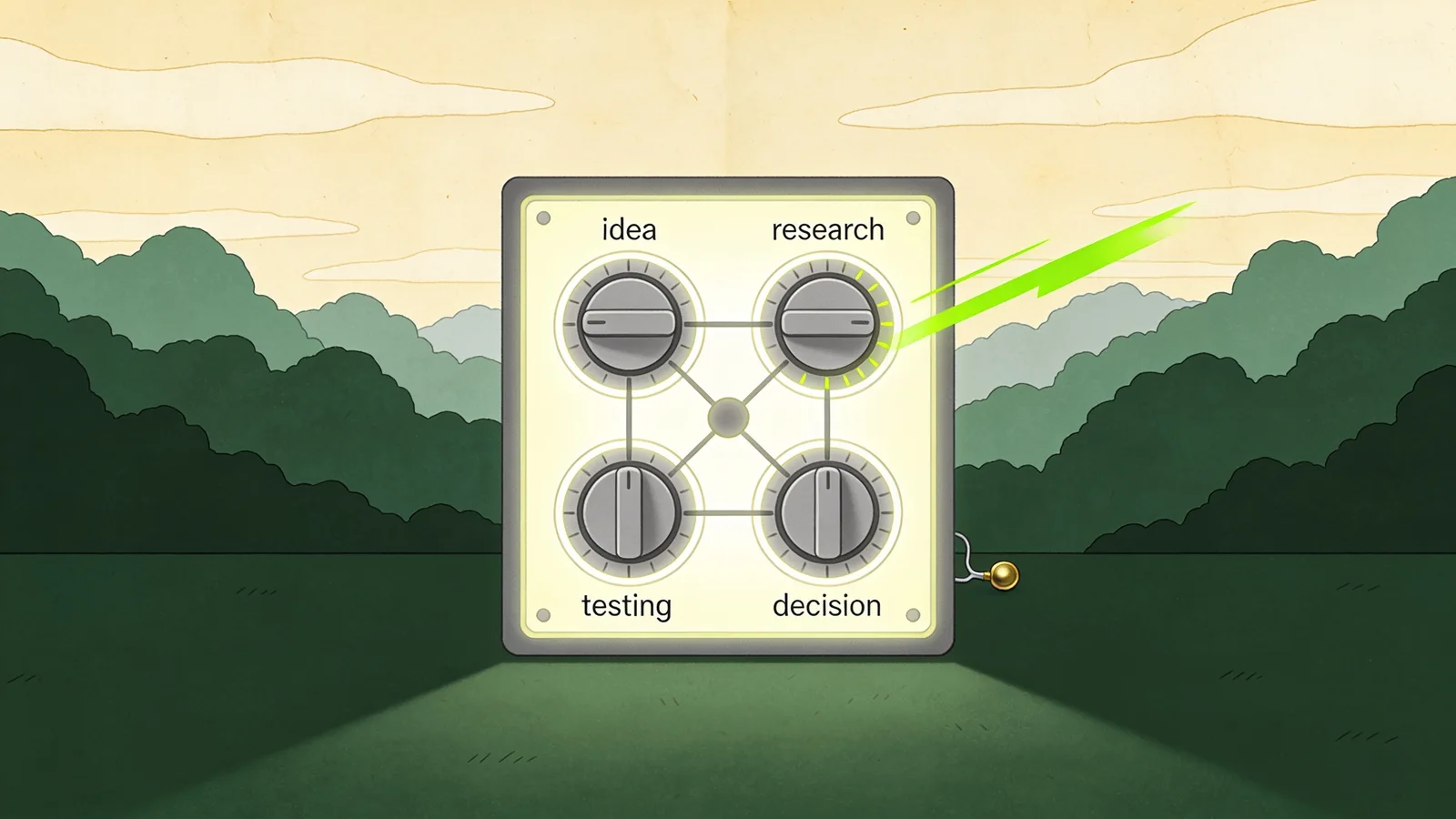
A founder innovation OS is the connected layer that carries an idea through capture, research, testing, and decision, so each stage builds on the last instead of starting over.
In practice, that means four things stay linked:
- The idea itself. What it is, in plain language, and how it's changed as you've learned things.
- What already exists. The prior art and the competitive landscape, checked early enough to matter.
- Whether it holds up. Market reasoning, cost reasoning, and the honest answer to "would someone pay for this."
- What you decided and why. A record you can return to, instead of re-deciding the same question every few weeks.
Miss any one of these and the whole system leaks. You can have a brilliant idea and no record of the prior art you checked. You can have a tidy spreadsheet and no memory of why you rejected the first three versions of the idea. The OS framing exists because these pieces need to move together, not because any one of them is hard on its own.
If you want the fuller definition and the reasoning behind it, this piece goes deeper: What Is an Innovation Operating System for Solo Founders?
What "Startup Innovation Management Software" Usually Gets Wrong
Most software marketed under that label is built for teams. It assumes a product manager, an engineer, a researcher, all logging into the same board and assigning tasks to each other. Strip away the team and the software doesn't fail exactly, it just becomes overhead. You're now managing a project management tool by yourself, for yourself, which is its own small tax on your time.
The better question isn't "which enterprise tool has a free tier." It's "what does a single person actually need to move an idea forward without a team behind them." That list is shorter than most software vendors want you to believe:
- A place to write down the idea honestly, including the weak spots.
- A way to check what already exists before you spend money building something already patented or already on the market.
- A way to test the business logic: who pays, what it costs, whether the math works.
- A record of decisions, so you're not rethinking the same fork in the road every month.
That's the real shape of the tooling need. Not a Gantt chart. A thinking partner and a memory.
The Four Layers of a Founder Innovation OS
1. Capture, Without Losing the Thread
Most ideas die not because they were bad, but because they got scattered across three notes apps and a napkin and nobody ever pulled them back together. The first job of any system is boring: keep the idea in one place, in a form you can actually read back later.
2. Prior Art and Landscape Checking
Before you spend real time or money, it's worth knowing what already exists, both as issued patents and as products already on shelves or in app stores. This doesn't tell you whether your idea may qualify for a patent, that's a legal question for a patent attorney, but it does tell you whether you're about to reinvent something, or whether there's a crowded field you'd be walking into. EntreDash's methodology page explains which databases get checked and how findings get cited, which is worth understanding before you trust any tool's search results, including ours.
3. Testing the Idea Honestly
This is where most solo founders skip steps, not out of laziness but because it's uncomfortable to pressure test your own idea. A structured pass through market reasoning and cost reasoning catches problems while they're still cheap to fix. If you haven't run your idea through something like this yet, A Startup Idea Pressure Test Tool: What It Is and How to Use One walks through what a real pressure test looks like, and How to Do a Startup Idea Financial Viability Assessment Before You Spend a Dime covers the money side specifically.
4. A Decision Record You Can Trust
Six months from now, you will not remember exactly why you dropped feature X or pivoted away from audience Y. Write it down when you decide it. A founder innovation OS treats this record as core infrastructure, not an afterthought, because a solo founder without a paper trail ends up re-deciding the same questions on a loop, which is its own kind of stall.
How This Differs From "Just Using ChatGPT"
A lot of solo founders already talk to an AI chatbot about their idea, and that's a reasonable instinct. But a single open-ended conversation isn't a system. It doesn't remember your prior art search from three weeks ago unless you paste it back in. It doesn't hold your financial assumptions next to your competitive landscape. It answers the question you asked, not the ten questions you forgot to ask.
The founder innovation OS framing is useful precisely because it asks for structure: capture, check, test, decide, in a loop that repeats as the idea evolves. A general-purpose chatbot can help with pieces of that loop. It won't build the loop for you. For a closer look at what AI can and can't responsibly do at this stage, see What Can an AI Business Strategist Actually Do for a New Founder?
A Simple Test: Do You Actually Have an OS, or Just Tools
Ask yourself three questions:
- If someone challenged your idea today, could you pull up what you already know about the prior art without a fresh search?
- If you changed your mind about the target customer last month, is that decision written down anywhere, with the reasoning?
- Could you hand your current notes to another person and have them understand where the idea stands, right now, without a half-hour explanation?
If the honest answer to any of these is no, you have tools, not a system. That's not a failure. It's just where most solo founders start, and it's fixable.
Where to Start Building One
You don't need to build this from scratch with a stack of separate apps. The point of naming it as an operating system is that it should feel like one thing, not five. A reasonable starting point is a single session where you lay out the idea, get a read on the existing landscape, and get an honest verdict on where it stands before you invest more time or money.
EntreDash's free AI advisory board does exactly that: you describe the idea, it checks it against existing patents and products, and it gives you a straight assessment of where the idea stands and what to check next. It's the natural first move if you're still at the stage of wondering whether an idea is worth building on, not the last step in the process, but the honest first one.
If you want to see the fuller mechanics before you commit any time, how EntreDash works lays out the whole path end to end, and the IP Education Center is a good place to get comfortable with terms like prior art before you go further.
The Bigger Point
Calling this a founder innovation OS isn't about the label. It's about refusing to accept that a solo founder should be worse-equipped than a funded team just because there's one person instead of ten. A team has departments. A solo founder needs the equivalent, held together in one connected system instead of scattered across a dozen open browser tabs.
That's the shift worth making before you build much further: stop collecting tools, and start building the one system that connects them.