Sparks at 2am. Patent pending by graduation.
Turn your random ideas — the chem-class brainstorm, the dorm-room invention, the 2am sketch — into something you can put on a resume, a college application, or out into the world. Built for builders 16 to 24.
Past undergrad? See the main inventor site →
No idea yet? Spark one free → Turn whatever's annoying you into real directions worth chasing.
No signup needed. Free to try, deletable anytime.
From a random idea to a protectable, buildable business.
Entrepreneur Dashboard
Your whole spark-to-business journey — all in one dashboard.
Record it before it slips your mind, or someone beats you to it
Your idea in plain words. A sentence or two is enough.
Strategize with your specialty Coach, and get challenged
A specialist runs a structured diagnostic, one question at a time.
Get a structured, in-depth, action-ready memo
A market memo built on real data, with a clear verdict and your next moves.
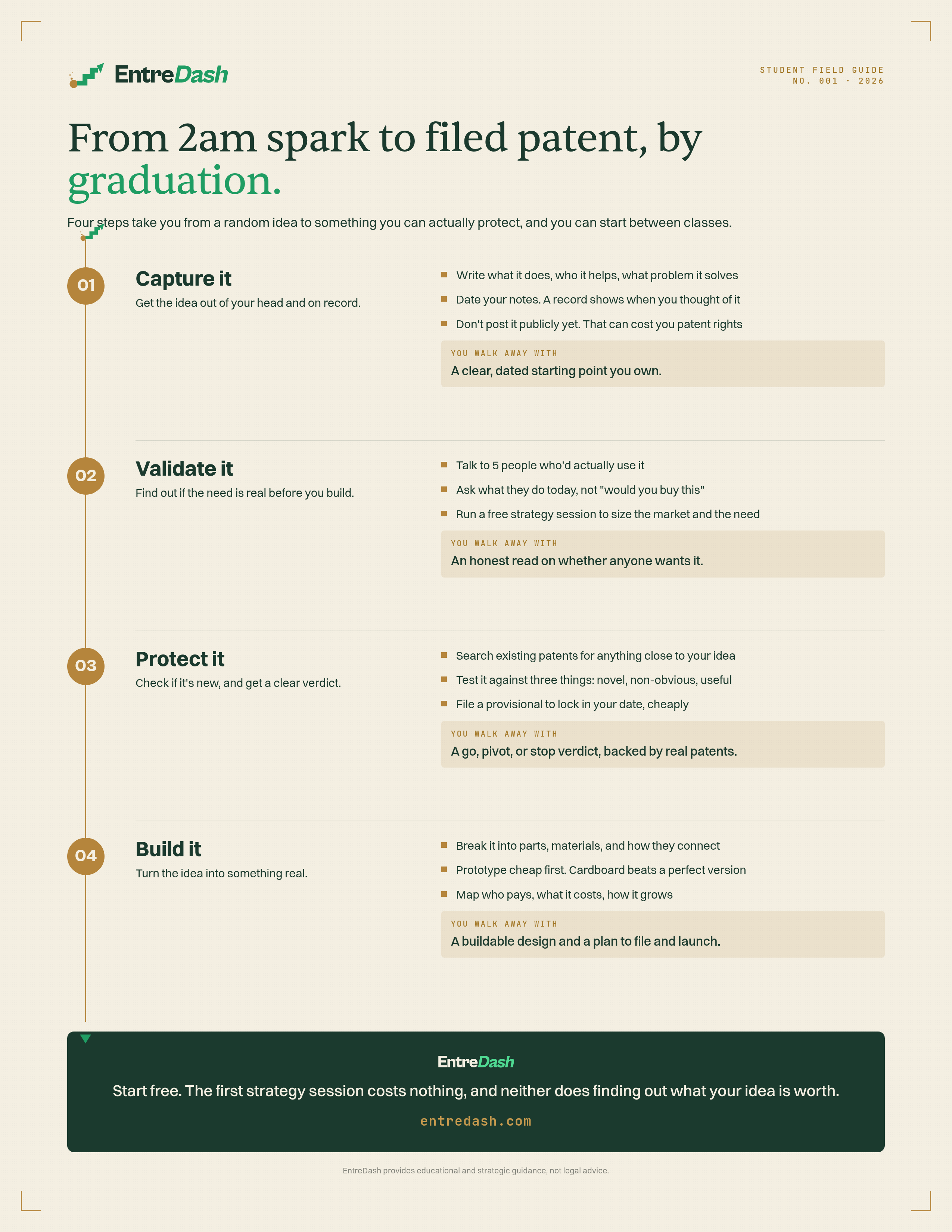
The student's one-page path to a filed patent.
Print it, pin it above your desk, and work the four steps between classes: capture the spark, validate the need, screen it against real patents, and build it into something you own. By graduation.
Four credentials most of your peers will never have.
Patent pending on your resume.
Most students will never have it. Show up to a college app, scholarship app, or internship interview with a patent-pending invention and a written strategy memo, and you stand apart — because you proved you can actually finish something.
Something you actually own.
Your senior project, hackathon idea, or dorm-room invention doesn't have to live in a Google Drive folder forever. We help you take it from "school project" to IP that belongs to you, with a paper trail of priority dates.
Lead a team. Ship a product. Make money.
The same strategy guidance founders pay $700+/hour for — prior art search, filing path, commercialization sequencing. You'll think and talk like a founder before your first internship.
Mental muscles that pay off for decades.
Original thinking. Structured analysis. Real follow-through. The habits that make a great inventor — or great founder, lawyer, researcher, product person — practiced on the stuff you actually care about.
Six structured deliverables.
Not six AI chat responses.
A product strategist, IP consultant, and financial analyst — each produces a real artifact. Plus a prior-art search plan, a buildable design breakdown, and a curated attorney match. Five live today, one on the way.
Click any card below to view the complete example →
A needs discovery memo
Market sizing, customer pain articulation, and a competitive landscape map. The first specialist conversation, before any patent work.
See the example memo →An invention strategy memo
A first-meeting writeup with a Go / Pivot / Stop verdict, real US prior-art citations, and a recommended filing path.
Read the example memo →A business case memo
Scenario-based 5-year revenue, cost, and EBITDA projections. Unit economics, breakeven, and a preliminary valuation range.
See the example memo →A prior-art search plan
The methodology a senior patent searcher builds before running queries: CPC classifications, keyword sets, and Boolean queries.
See the example strategy →A buildable design breakdown
Your idea broken into its real components — each with a function, materials, and how it connects. The foundation for prototyping and patent drawings.
See the example design →A vetted attorney match
Over 50,000 USPTO-registered patent attorneys and agents — enriched with practice-area research and accessibility signals.
Browse the marketplace →Every artifact above came from a real invention example we evaluated. Not screenshots, not mockups — the actual product output, scaled down.
Every invention takes the same five-step journey.
From the moment of "wait, what if…" to a product on a shelf or a patent on the wall — the path is the same, even if the timeline varies. EntreDash meets you at every stop after the spark.
Build the IP-driven product development habit early.
Most product courses skip IP. Most IP courses skip product. Three full curriculums, 56 lessons — covering intellectual property, new product development, and commercialization — so you learn to build with the patent in mind from day one. Free to browse, no signup needed.
Patents are one tool. There are others.
Most inventors think IP means patents. It doesn't. The IP landscape has four major instruments, and the best protection often layers two or three together.
Protects inventions and their function.
~20 years
e.g. A self-cooling water bottle
Protects names, logos, brand identifiers.
Indefinite while in use
e.g. The brand name on the bottle
Protects creative expression.
Life + 70 years
e.g. The packaging artwork
Protects confidential know-how.
As long as the secret holds
e.g. The cooling-element recipe
Protects how something works — the function or mechanism. Most students file this.
Protects how something looks — the visual appearance. Useful for product design.
A granted patent gives you the legal right to stop others from making, using, or selling your invention for the life of the patent. That's it.
It does not automatically pay you. You still have to commercialize, license, or assert it. The patent is the moat — you build the castle.
Three professionals. One coach. Your idea.
Most AI tools give you answers. EntreDash gives you a structured process — applied through three distinct professional lenses simultaneously: a product strategist, an IP consultant, and a financial analyst. By the time you finish, you'll think about every idea you ever have in a sharper way.
Advisory boards used to cost a fortune.
Now yours runs 24/7 on 10+ AI agents.
EntreDash proprietary AI agent workflow
Share your founder journey. Keep your invention private.
Building solo is hard. But under US patent law, talking about your invention publicly can permanently affect your ability to file. EntreDash is built to give you both — the community to grow as a founder, and the airtight privacy your actual idea needs.
Share your founder progress.
Posts about what you're learning, milestones you've hit, frameworks that clicked, mistakes you made. Builds your founder reputation in the community without ever exposing the actual invention.
Lock down what makes it patentable.
Your invention disclosures, strategy sessions, memos, and prior-art research stay encrypted in your private workbench. Never shared with the community, never visible to anyone except you.
Find the right teammates safely.
When you do want to bring someone in — a co-founder, a lab partner, a friend with the engineering chops — share specific ideas under an explicit, mutual confidentiality agreement. No accidental disclosure.
The Inventor Community is shipping in 2026. Strategy sessions, memos, and private workbenches are live today.
The workflow exists. You've just never had access to it.
The USPTO uses AI to classify every patent application that crosses its desk. Top law firms run AI-powered prior art searches before drafting a single claim. Fortune 500 IP departments pay six figures a year for patent-AI vendors most independent inventors have never heard of. The tools exist — and so does the workflow that decides what's worth using them on.
- ×Pay an attorney to evaluate every idea you bring
- ×File everything — expensive
- ×File blindly — wasteful
- ✓Run ideas through internal review first
- ✓Structured questioning, novelty checks, stage-gate triage
- ✓Only the strongest ideas escalate to outside counsel
EntreDash brings the same screening workflow Fortune 500 product development teams use — structured questioning, a clear verdict, a roadmap — within reach of every inventor. So when you do hire an attorney, you walk in with your best idea, not every idea, and only after you've built real confidence in it.
$49.99/mo isn't a subscription. It's seed capital for your future.
Most parents will say yes to a real ask with a real return. Treat them like the angel investor they are. Here's the pitch — show them this page, or read it out loud if you have to.
$49.99/month, billed annually (Family Bundle — one yearly charge of $599.88 for twelve months of access). That's roughly one streaming subscription plus a weekly bubble tea. Or $74.99/month if you'd rather keep it month-to-month — cancel anytime.
Strategy sessions with a coach that thinks like a product strategist, an IP consultant, and a financial analyst. A compiled invention strategy memo for every idea. The full Education Center — 56 lessons across IP, product development, and commercialization. Four family seats so siblings can use it too.
A patent-pending credential on a resume most peers will never have. A portfolio piece you can show in college and internship interviews. Founder-grade skills: structured thinking, original problem framing, real follow-through. And — for real ideas — the actual IP, owned by you.
SOC 2 Type II-audited infrastructure. Enterprise AI under a contractual no-training agreement — nothing you write here is used to train models or shared with anyone. Cancel anytime, delete everything anytime. Full Trust & Security audit →
You get better at inventing the same way you get better at anything — by doing it, not by reading about it. Every idea you run through this framework is a rep. The earlier you start, the more reps you've stacked up by college, by grad school, by your first job. The compounding starts now.
Start free. Grow when you're ready.
Pay for one item at a time, subscribe monthly, or pay per invention for a serious patent filing. Start small, and switch anytime.
Small, one-off purchases. No subscription, nothing recurring.
Ten idea sparks to shape a daily annoyance into a real solution direction. Your first 3 are free.
One strategy session and its memo, with PDF, share link and export. Your first is free.
Three expert memos on one idea (product, IP, and financial), each with PDF, share link and export.
Founder build tools to develop two ideas — canvas, customer discovery, and more.
Validating regularly? A monthly plan lowers the cost per session.
Start here.
- Unlimited idea capture
- 1 strategy session + memo per month
- Choose from Product Strategist, IP Consultant, or Financial Analyst
- Real prior-art citations
- View-only memo access
Go all in.
- Unlimited idea capture
- 3 strategy sessions + memos per month
- Full Education Center
- PDF download + memo compare
- Daily contextual IP insight
One subscription for the whole family.
- Up to 4 separate member accounts
- Unlimited idea capture for every member
- 12 strategy sessions per month, pooled across the family
- A strategy memo for every session, from any of the three specialists
- Each family member’s work stays private
$499.99 per asset · vs. ~$10,000+ in attorney hours to do the same triage.
Patent attorneys bill $400–$700 per hour. A novelty opinion plus prior-art search typically runs 15–25 hours before they even start drafting — that's $6,000 to $17,500 just to find out whether the idea is worth filing.
Run an idea through EntreDash's Pay-per-invention path first and you get deep prior-art search, the drafting workbench, a recommended pathway plan, and an attorney intro for $499.99. By the time you do hire counsel, you've already done the expensive thinking — they bill far fewer hours, and you walk in knowing exactly what you want them to do.
Filter your ideas first. Pay lawyers only for the ones worth filing.
Self-serve checkout for the Family Bundle is launching soon. In the meantime we'll set up your family directly — fast.
Your sandbox for practicing every founder skill.
Most inventors learn this on the job — in their late thirties or forties, with a real cap table, a real burn rate, and no second chances. EntreDash lets you train the same muscles now, on stakes you can afford to get wrong — so when the real moment comes, you've already had the reps.
Find the friends worth building with.
The friends who'll show up at 11pm to work on the prototype. The lab partner who gets the engineering. The future co-founder you don't know yet. Practice spotting the right collaborators — and bringing them in without exposing the IP.
From scribbled note to filed and launched.
Most founders never see the full journey until they're already in the deep end. Run a real idea through every stage — strategy session, memo, prior art, filing path, commercialization — while the only thing on the line is your own learning.
Your parents are angels in waiting.
Convince them to fund $49.99/mo and you've just closed your first round. Practice for every term sheet conversation, every demo day, every VC meeting you'll ever have. The actual pitch deck is just below.
Questions you'll have. Questions your parents will have.
Ask an AI instead.
It has nothing to sell you.
Pick one below. It'll tell you what EntreDash is, who it's for, and whether it's worth your time, in its own words.
Test your first idea, free.
Five minutes. No signup. See exactly what the memo looks like before you commit to anything.